There’s a particular pattern of discourse that I’ve seen, both in person and online, that has bothered me subconsciously for a while. It’s a really easy trap to fall into even in a setting with good norms and intentions on both sides, so it may be helpful to articulate.
Sophie is an anthropology major at Columbia. She’s passionate about building a society that gives everyone a good standard of living. She reads about the tremendous wealth inequality in the United States and sees it with her own eyes every day as she walks to campus from her apartment in West Harlem. She believes that American institutions need fundamental reform: a nationalization of the housing and health care industries, much stricter regulation of the banking sector, and a far more progressive tax code. Sophie is a democratic socialist.
Lily is an economics major, also at Columbia. Much like Sophie, she lives in West Harlem and encounters wealth inequality every day. She donates to charities that aim to reduce poverty. But Lily doesn’t think the progressive reforms that democratic socialists support would improve poor people’s quality of life. She believes that nationalization and strict regulation would stifle economic growth. Instead, Lily is passionate about occupational licensing reform: she sees licensing laws for professions such as barbers as an unnecessary burden to poor people who would be perfectly good barbers but can’t afford the training they’d have to undertake. Lily is a libertarian.
Sophie and Lily meet at a party, where they get into a discussion of the U.S. tax code. Sophie tells Lily that she supports a 70% income tax rate for the richest Americans, but Lily objects. They get into a discussion, and it turns out that their main crux of disagreement is how rich people would respond to such a policy change. Lily thinks rich people would respond by aggressively seeking out loopholes in the tax code, essentially making their tax rate depend primarily on how unscrupulous they are willing to be. Sophie believes that this would only happen to a small degree and that this effect would be dwarfed by the positive effects of extra government revenue.
Lily, who has already considered this view and rejected it, recommends that Sophie read Milton Friedman’s Capitalism and Freedom to understand the subject better. Sophie asks Lily to describe the book’s central arguments in support of Lily’s belief. Lily gives a brief outline of the argument, but ultimately says that it would take her a while to restate the argument in enough detail to make it cogent and says that Sophie should read the book if she wants to understand the details.
***
At first glance, recommending Capitalism and Freedom seems like a totally reasonable thing for Lily to do. She found the book illuminating, so she recommended it to Sophie, so that Sophie could understand Lily’s position. The problem is — she put Sophie in a position where Sophie was no longer completely free to disagree. Essentially, Lily said “The argument in favor of my position is long and needs to address several counterarguments. It would take a while for me to lay it all out, but conveniently it’s all been written out in this great book!”. In response, Sophie has a few options:
- Defer to Lily, as she’s researched the subject more than Sophie has.
- Continue to disagree with Lily.
- Nod and say she’ll take a look at the book, postponing the discussion to a later point.
I’d argue that these are all bad outcomes of the conversation. Outcome 1 is bad because there’s no reason for Sophie to defer to Lily in particular, just because she happened to be the specific econ major she met at the party. Plenty of econ majors, and plenty of economists, would disagree with Lily; if they exist, and know just as much as if not more than Lily, why should Sophie defer to Lily and not to them?
Outcome 2 is bad because of a failure to learn: the disagreement isn’t pursued enough to get resolved or for either party to hear an argument they hadn’t considered yet. Further, Lily is — perhaps justifiably — not thrilled with this outcome. Economics is complicated and takes time to understand. She’s taken that time and has given a recommendation to Sophie on how to do the same. Isn’t it a little inappropriate for Sophie to continue to disagree without addressing the arguments given in Capitalism and Freedom?
But what usually happens in these situations, in my experience, is outcome 3. The problem with outcome 3 is that it’s probably a bad deal for Sophie. Sophie has, to some extent at least, forfeited the right to publicly disagree with Lily until she reads Capitalism and Freedom. (Or at least that’s how I usually find myself feeling in Sophie’s position.) If she says she’s in favor of a 70% tax on the rich in Lily’s presence at a later point, Lily could be like “Hey so did you read that book I recommended?” and Sophie would sheepishly say “No, not yet.” Further, even if Lily is not around, Sophie’s Lily-inside-her-head will be pestering her: “You haven’t considered what Milton Friedman has to say, have you now?”
Of course, Sophie could actually read the book. And that’s great — she can now feel justified in disagreeing with Lily (if she still does) and can reach out to Lily to discuss further. But reading a book is costly: it takes a whole lot of time! If Sophie had to read a book every time she disagreed with someone, she would do nothing but read and still wouldn’t be able to resolve half her disagreements. This means that Sophie needs to pick and choose, carefully selecting the special few disagreements that are important enough for her to read up on extensively. And most likely, the particular disagreement she had with Lily won’t end up making the cut.
So in conclusion, by recommending Sophie a book to read, Lily forced the conversation into a place with no good outcomes, save the unlikely possibility that Sophie ends up reading it.
***
So what could Lily have done instead? One plausible answer: she could have taken the time to engage further with Sophie, laying out the main points of Friedman’s book and addressing Sophie’s objections. That is, Lily could have continued the conversation just as it had been going before, now drawing most of her arguments from the book.
There’s a nice explanation for why Lily and Sophie can have a reasonable conversation this way, even though Lily obviously doesn’t have the time to explain the book’s arguments in full. One can think of a book that argues in favor of some position or ideology as a tree. The root of the tree is the position itself, and each branch represents one of the central arguments in defense of the position. Now, for each of those arguments there are several counterarguments to consider. These counterarguments are all branches emanating from each main branch. Then, the book supplies a response to each counterargument — those are the third-level branches. And so on. That’s why books are so long: the number of arguments to consider is exponential in the depth at which the author wants to explore the subject, so even a relatively shallow treatment could take many pages.
A discussion, on the other hand — like the one Sophie and Lily are having, — is simply a path (or perhaps a few paths) from the root of the tree toward to its leaves. Lily describes a high-level argument in favor of a flatter tax rate; Sophie counter-argues; Lily objects to Sophie’s argument; and so on. In this way, Lily and Sophie explore small parts of the tree. It’s not as good as exploring the whole tree, but it can still be useful (particularly if each of them always chooses to present the argument that they believe to be strongest).
But at the same time… I think it’s reasonable for Lily to not be willing to discuss Friedman’s arguments in detail. For one thing, Lily might not be able to do so: being able to address any one of Sophie’s possible lines of counterargument would entail having the book essentially memorized. And sure, Lily and Sophie could have the discussion over private message so that Lily can browse and cite Friedman’s book as much as she wants, but that requires Lily to dedicate a lot of time — time she might not have. Also, I think that Lily should have a general freedom to not engage if she so wants: in most circumstances, people should not be forced to have a conversation they’d rather not have.
***
So I don’t have a problem with what Lily did when she recommended Friedman’s book but didn’t engage much further. Instead, I have problems with the norms I’ve seen surrounding this situation.
To slightly restate Sophie’s options, they are:
- Defer to Lily.
- Continue to disagree with Lily.
- Read the book and have a followup conversation.
The problem is that under our current norms, option 2 isn’t really much of an option for Sophie. At best, she feels sheepish disagreeing with Lily despite not having a response to the work Lily cited. At worst, disagreeing with Lily may not be socially acceptable for Sophie: it’s a bad look to basically say “Look, I don’t have time to read the book, but I’m going to disagree with you anyway.” Or maybe Sophie continues disagreeing, but in private, not willing to state her disagreement publicly; that’s not great either.
If by citing a book, Lily forces Sophie to choose between reading the book or (at least publicly) deferring — and realistically Sophie probably won’t read the book — then that gives people in Lily’s position some bad incentives. It’s not great if citing a book wins you an argument, especially if you don’t understand the book particularly well. And the equilibrium of this norm is some sort of “expert citation” arms race where each side searches for experts supporting their view, without necessarily understanding the underlying points of discussion.
So what should our norms look like in this situation? Something like this seems pretty good to me:
- Lily should be able to point Sophie to a book, and shouldn’t be required to detail the book’s points to Sophie.
- But if Lily chooses to do this, Sophie should feel no pressure from anyone — Lily or others — to either read the book or defer to Lily. She should be able to continue to publicly disagree without having considered the arguments that Lily pointed to.
Another way to view this norm: by citing a book and not engaging further, Lily is choosing not to devote a huge amount of time to her discussion with Sophie. Which is okay! But then Sophie should also have the social freedom to maintain her stance without devoting a huge amount of time to resolving her differences with Lily.
In essence, Lily and Sophie have a contract in front of them. The contract is: Lily will put in effort to explain to Sophie the argument against a highly progressive tax system, and in return Sophie will try her best to understand the argument. Lily and Sophie could sign this contract; this means having an in-depth conversation on the subject. Or, they can choose not to sign the contract: Lily has no obligation to try to explain Friedman’s arguments to Sophie, and Sophie has no obligation to read Capitalism and Freedom. For this reason, I’ll call the norm I’ve just proposed the “equal effort contract” norm, in contrast with the “read or defer” norm I see in many places.
***
While the equal effort contract norm seems better than the read or defer norm in most situations, I don’t think that’s always the case. While appealing, equal effort contracts demand equal — or at least similar — amounts of effort from both parties. In practice, this can be pretty unfair. Imagine that, in addition to classes, Lily has to work two jobs to pay for her education and support her family. Meanwhile, Sophie is taking a relatively light class load and doesn’t have to worry about finances. It seems inequitable to ask that Lily put as much time into explaining Friedman’s ideas as Sophie into understanding those ideas.
Perhaps in this case it’s okay for Lily to recommend Friedman’s book and still have some sort of expectation that Sophie read or defer. Indeed, the equal effort contract norm would be generally disadvantageous to Lily: because she doesn’t have spare time, she won’t be able to effectively spread her ideas to others. In this way, the equal effort contract norm systematically advantages those with more expendable effort and free time.
But the read or defer norm suffers from a similar issue, though this time it’s people in Sophie’s conversational position (i.e. learners) who are disadvantaged if they have less time on their hands. That’s because reading a book is an option for someone with a lot of available time; but under the read or defer norm, those with less time have no choice but to defer.
A better solution is an “equitable effort contract” norm. A nice illustration of the difference between equality and equity:
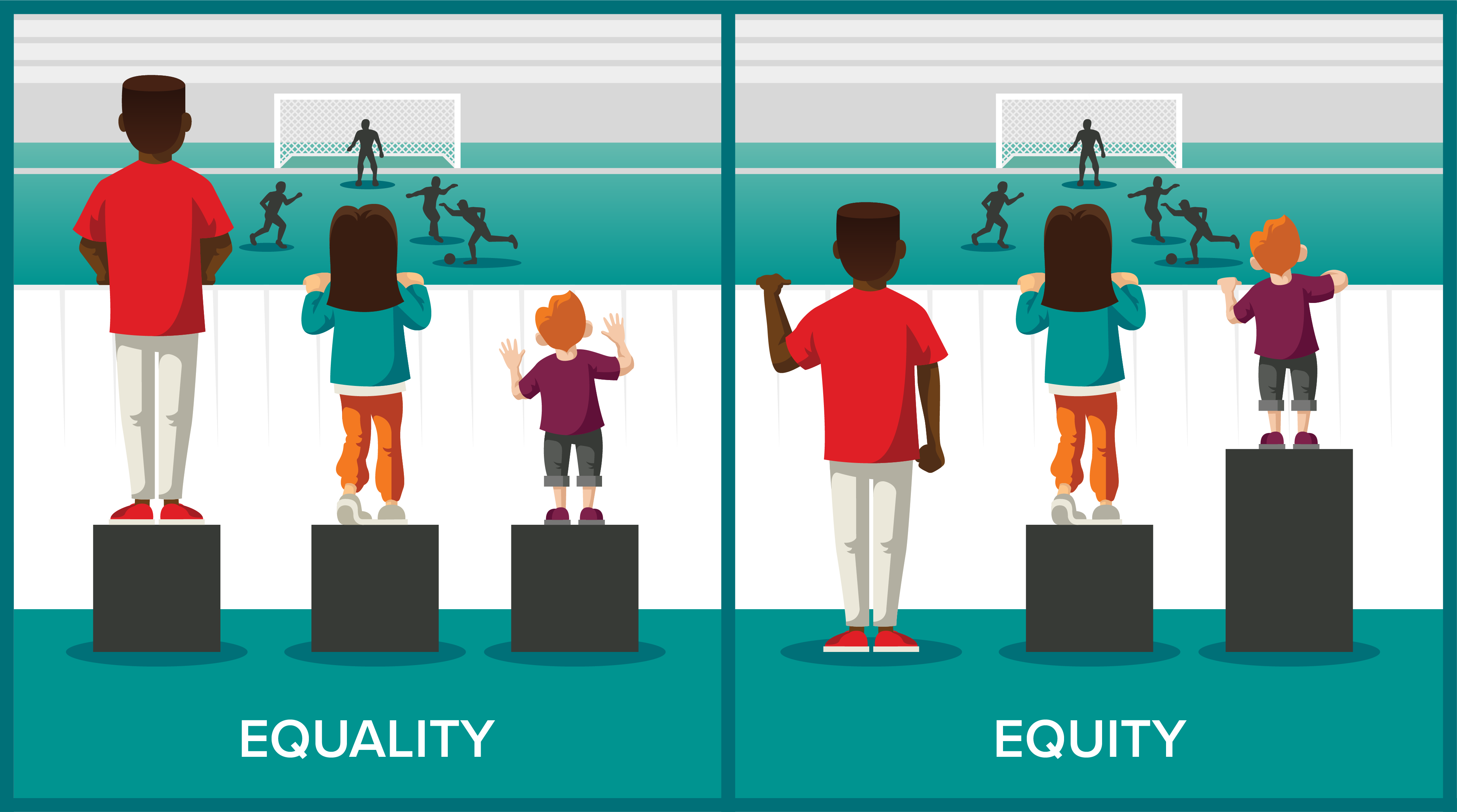
If Sophie has more expendable time and effort than Lily, Sophie should put somewhat more effort into understanding Lily’s ideas than Lily into explaining her ideas. Similarly, if Sophie is more time-constrained than Lily, it makes sense to expect Lily to put in more effort into presenting her ideas to Sophie effectively and efficiently.
In some contexts this is already a norm. Think about presidential briefings on national security, for instance. The president is extremely busy and has to juggle many different priorities. Those compiling the briefing spend their whole day figuring out how to present the briefing in the best way possible. This makes sense: it is a more equitable distribution of effort.
There is a matter that remains unsettled, though: what exactly is the way for Lily and Sophie to distribute effort equitably? Should effort contracts be structured so that participants pledge the same percentage of the amount of free time they have, or would it be better for the percentage to be an increasing function of the amount of free time? This question, of course, needs to be settled by Lily and Sophie before they can begin their discussion.


I would consider the problem between Lily and Sophie in a different view – conceptually deeper, but procedurally much simpler – Lily and Sophie simply don’t want to listen each other (which happens unfortunately to majority of us these days).
The challenge to be addressed is how to make people to open their minds to opposite views, listen to each other and be ready to change/modify their opinions.
It happened to me on this 4th of July at the block party: I had an interesting conversation with the intelligent neighbor-democrat/liberal and both of us left the conversation with “updated” views on the subject…
LikeLike