In this day and age, celebrities have a lot of influence over our politics. Garthwaite and Moore estimated that Oprah Winfrey's endorsement of Barack Obama in 2008 netted him an extra 1 million votes [1]. More recently, an Instagram post by Taylor Swift led over 160,000 Americans to register to vote prior to the 2018 … Continue reading Finding Shawn Mendes
Should FiveThirtyEight’s elasticity index have a wider spread?
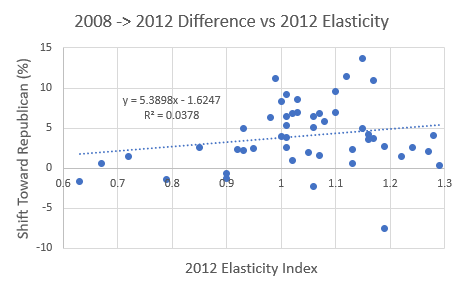
[Edit: I no longer stand by the conclusions of this post. For more, see "How much do you believe your results?"] In 2012, Nate Silver wrote about elastic and inelastic states. An elastic state is one with lots of swing voters. This means that if the national electorate shifted by one percentage point, you would … Continue reading Should FiveThirtyEight’s elasticity index have a wider spread?
A few things to watch this Tuesday
EDIT: See also, FiveThirtyEight's article on the same topic. Off-year elections will be happening across the US this Tuesday, November 5th. Here are some races I'll be keeping an eye on: Probably the most important election is in Virginia, where control of the legislative branch (both the Senate and House of Delegates) is up for … Continue reading A few things to watch this Tuesday
What to do about undefined expectations?
(Related: Lofty expectations) In August of 1939, just as World War II was beginning, physicists Albert Einstein and Leó Szilárd wrote a letter to President Roosevelt, letting him know about the theoretical possibility of nuclear weapons and suggesting that the United States start a nuclear program. The letter resulted in the Manhattan Project, which led … Continue reading What to do about undefined expectations?
Lofty expectations
This is the excerpt for your very first post.
General election polls *are* predictive one year out
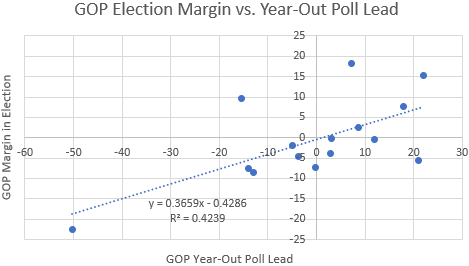
(Also, how to deal with leverage points when doing linear regression) If you closely follow FiveThirtyEight's politics coverage, like I do, there are some mantras you hear repeatedly. One of the most common is: general election polls are meaningless until the election starts getting close. See for instance A Year Out, Ignore General Election Polls; … Continue reading General election polls *are* predictive one year out
Least squares regression isn’t arbitrary
In 11th grade I took my high school's statistics class. When we learned about linear regression I raised my hand and asked why we were minimizing the sum of the squares of the residuals rather than, say, the sum of the absolute values. If my memory serves right, my teacher said that minimizing the sum … Continue reading Least squares regression isn’t arbitrary
Incentives in the election-charity platform
Note: this is a follow-up to an earlier post in which I describe a hypothetical platform for matching donors to opposing campaigns and sending their money to charity instead. Click here to read the post (this post likely won't make sense if you haven't read that one). In response to my post about a platform … Continue reading Incentives in the election-charity platform
Provisional opposition
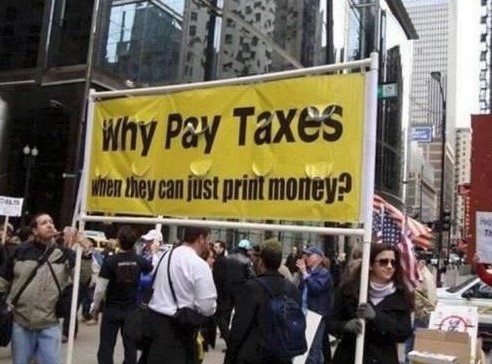
A couple weeks ago I saw this on Twitter: My immediate reaction was, "This sounds pretty dumb." After all, printing money doesn't generate new wealth. After a few seconds I revised my opinion to, "This is probably a terrible idea, but for reasons I don't understand." What I realized was that while printing money doesn't … Continue reading Provisional opposition
Are we due for another recession? Probably.
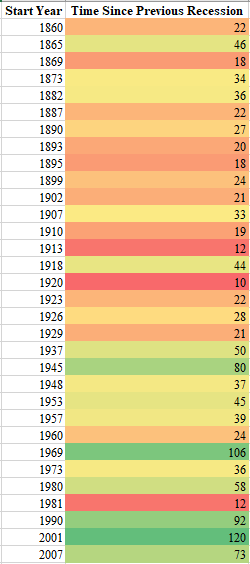
Perhaps the most famous statistical fallacy is the gambler's fallacy. To quote Wikipedia, the gambler's fallacy is "the mistaken belief that if something happens more frequently than normal during a given period, it will happen less frequently in the future (or vice versa)." The canonical example of the fallacy is gamblers who reason that, since … Continue reading Are we due for another recession? Probably.